Transfer Rewards Points: Unlock 30% More Value Now
Advertisements
Strategically transferring rewards points can increase the value of loyalty balances when the right partners, ratios, and promotions are available.
Credit card points may be worth one amount when redeemed directly and considerably more when transferred to an airline or hotel program.
The key is understanding transfer partners, award availability, fees, timing, and whether a redemption actually delivers better value than simpler alternatives.
The Core Principle: Maximizing Value Through Transfers
Rewards points do not always have a fixed value because redemption options can produce very different returns depending on the program.
A point used for cash back may deliver a predictable value, while the same point transferred to a travel partner could potentially unlock a stronger redemption.
This flexibility is why transferring rewards points can be powerful when the transfer supports a specific high-value booking.
Key Players in the Rewards Transfer Ecosystem
Several major U.S. credit card programs allow eligible points to be transferred to airline or hotel loyalty partners.
American Express Membership Rewards, Chase Ultimate Rewards, Citi ThankYou Points, and Capital One Miles are among the best-known transferable currencies.
Each program has different partners and transfer rules, so the strongest option depends on where the traveler wants to book.
Identifying High-Value Transfer Partnerships
Not every transfer partner offers the same potential value, even when the nominal exchange ratio appears identical.
Some hotel and airline programs can offer attractive redemptions for premium travel, while others may provide less value than direct booking or cash back.
Comparing the cash price, award price, taxes, and transfer requirement helps determine whether transferring rewards points makes sense.
Understanding Transfer Ratios and Bonuses
A transfer ratio determines how many airline miles or hotel points are received for each credit card point transferred.
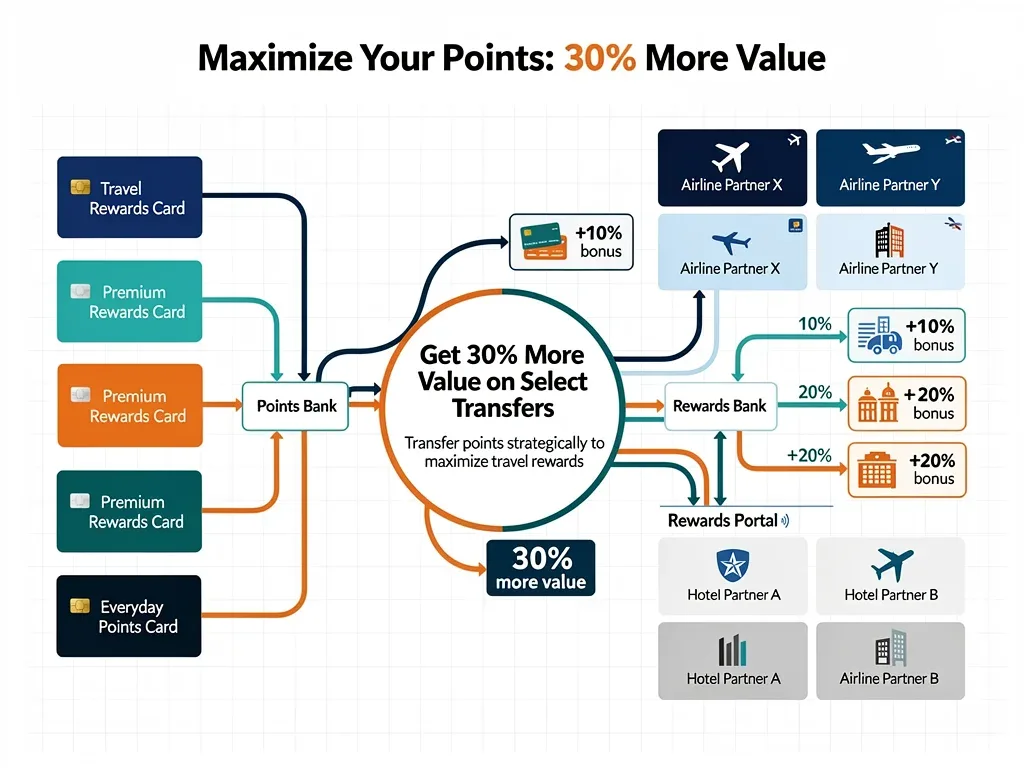
Temporary transfer bonuses can increase the number of points received, sometimes making an otherwise average redemption more attractive.
A 30% bonus means more partner points are received, but it does not automatically mean the final redemption is worth exactly 30% more.
Strategic Timing for Optimal Transfers
Transfers are usually safest when award space has already been identified and the traveler is ready to complete the booking.
Once points move to a partner program, transfers are typically difficult or impossible to reverse.
Waiting for appropriate award availability and a useful bonus can reduce the risks associated with transferring rewards points too early.

Navigating Transfer Fees and Limitations
Before initiating a transfer, cardholders should review fees, minimum transfer amounts, processing times, and partner-program restrictions.
Some transfers may involve additional charges, while others can take longer than expected and create problems when award availability is limited.
These details can reduce the practical value of a transfer, making it important to calculate the entire redemption before moving points.
Case Studies: Realizing More Value
A traveler may receive better value when transferable points are moved into a loyalty program offering an attractive award price.
For example, a hotel stay or premium-cabin flight can sometimes require fewer transferred points than the number needed through a direct travel portal.
The result depends on the specific dates, program rules, transfer ratio, taxes, and cash price rather than a universal percentage increase.
Tools and Resources for Smart Transfers
Point-tracking tools can help consumers organize balances across several credit card, airline, and hotel loyalty programs.
Specialized travel-rewards websites and communities can also provide information about temporary bonuses, award availability, and program changes.
Using several sources can make it easier to compare options before transferring rewards points into a partner account.
Future Trends in Rewards Point Transfers
Transferable rewards programs continue to evolve as issuers add partners, adjust benefits, and modify redemption structures.
Dynamic award pricing and personalized offers may make it increasingly important to compare the value of each redemption individually.
Consumers who remain flexible and monitor program changes can adapt their transferring rewards points strategy as conditions change.
Key Aspect | Brief Description |
|---|---|
Value Discrepancy | The same points can deliver different value depending on the redemption method. |
Transfer Bonuses | Temporary promotions increase the number of partner points received. |
Strategic Timing | Transfer when award availability and redemption value have already been evaluated. |
Key Issuers | Amex, Chase, Citi, and Capital One offer major transferable rewards programs. |
Frequently Asked Questions About Rewards Point Transfers
What does unlocking 30% more value mean in practice?▼
A transfer bonus can provide 30% more partner points, but the actual increase in redemption value depends on the award price, cash cost, taxes, and alternative uses of the original points.
Which credit card programs are best for transferring rewards points?▼
American Express Membership Rewards, Chase Ultimate Rewards, Citi ThankYou Points, and Capital One Miles are major options, but the best program depends on the partners you actually use.
Are there any fees associated with transferring rewards points?▼
Some transfers may involve fees or taxes, while many do not. Always review the issuer's current transfer terms before moving points.
How quickly do points transfer to partner programs?▼
Transfer times vary by issuer and partner. Some may process quickly, while others can take longer, which matters when award availability is limited.
Is it always better to transfer points than redeem for cash or gift cards?▼
No. Transfers can offer excellent value for certain travel bookings, but cash or direct redemptions may be better when flexibility, simplicity, or guaranteed value matters more.
What This Means
Successful transferring rewards points depends on understanding how partner programs convert points into actual travel value.
Transfer bonuses can improve an opportunity, but they should be evaluated alongside award availability, fees, cancellation rules, and alternative redemption options.
The strongest strategy is usually to keep transferable points flexible until a specific redemption offers clearly better value than the available alternatives.