Maximizing Rewards: 2 Cents Per Point Value 2026
Advertisements
Maximizing rewards redemption in 2026 requires comparing the value of each redemption instead of assuming every point should deliver two cents.
Travel rewards can produce strong value, but results vary by loyalty program, transfer ratio, award availability, cash price, taxes, and fees.
A better strategy is to establish a realistic value benchmark for each rewards currency and redeem when an available option exceeds it.
Understanding Rewards Value in 2026
Loyalty points do not have one universal value because airlines, hotels, banks, and other programs use different redemption structures.
Some rewards have relatively predictable cash-equivalent values, while transferable points can vary substantially depending on the partner selected.
This variation makes calculating redemption value essential before deciding whether to spend points or pay cash for a purchase.
What Does Two Cents Per Point Mean?
A redemption worth two cents per point means every 10,000 points effectively replace approximately $200 of otherwise comparable spending.
For example, a $500 booking costing 25,000 points would theoretically produce two cents per point before accounting for additional charges.
Taxes, fees, resort charges, award surcharges, or benefits earned on paid bookings can change the true value of that redemption.
Two Cents Is a Target, Not a Rule
Many airline, hotel, and credit card currencies have typical redemption values below two cents per point in current 2026 estimates.
Other flexible currencies can occasionally reach or exceed that level when transferred strategically to suitable airline or hotel partners.
The appropriate benchmark therefore depends on the specific currency rather than applying the same two-cent threshold to every program.
Calculate Redemption Value Before Using Points
The simplest calculation compares the cash price avoided with the number of points required for the same booking or purchase.
Subtract unavoidable cash charges from the value received before dividing the remaining amount by the number of points redeemed.
This provides a practical cents-per-point figure that can be compared with alternative uses of the same rewards currency.
A Simple Points Value Formula
Start with the comparable cash price, then subtract taxes or fees that still need to be paid on the award.
Divide the remaining value by the points required and multiply the result by 100 to express the answer in cents.
This method is useful for maximizing rewards redemption because it converts different options into one comparable metric.
Do Not Ignore Cash Booking Benefits
A paid booking may earn airline miles, hotel points, elite-status credit, or credit card rewards that an award booking does not provide.
Those benefits can make the cash option more attractive even when the basic cents-per-point calculation appears favorable.
Travelers should also consider cancellation flexibility and fare restrictions when comparing a reward booking with its paid equivalent.
Flexible Points Can Create More Options
Transferable credit card rewards can be valuable because they may be moved into several airline or hotel loyalty programs.
This flexibility lets cardholders compare multiple partners before deciding which program offers the most useful redemption for a trip.
However, transfer ratios and eligible partners differ by card product, so the same rewards ecosystem may not treat every cardholder equally.
Why Transfer Partners Matter
A point transferred to an airline or hotel program can sometimes produce greater value than redeeming it directly through a card issuer.
The advantage depends on the transfer ratio and the number of partner points required for the specific award being considered.
Transferring without confirming availability first can be risky because most loyalty transfers cannot simply be reversed afterward.
Compare the Transfer Ratio First
A transfer advertised as access to a valuable program is not automatically attractive if the card converts points at an unfavorable ratio.
Changes introduced during 2026 show why cardholders must verify the current ratio associated with their exact credit card product.
A lower transfer ratio can materially reduce the effective value received even when the destination loyalty program itself remains useful.
Use Transfer Bonuses Strategically
Credit card issuers periodically offer temporary bonuses when members transfer rewards into selected airline or hotel loyalty programs.
A transfer bonus increases the number of partner points received and can reduce the amount of transferable currency required for an award.
These promotions can improve redemption value, but only when the destination program already offers an award the traveler actually needs.
How Transfer Bonuses Improve Value
A 25% transfer bonus would convert 40,000 transferable points into 50,000 partner points when the standard ratio is one-to-one.
If the award price remains unchanged, fewer original credit card points are required to obtain the same flight or hotel booking.
This can support maximizing rewards redemption, especially when combined with already favorable award availability.
Do Not Transfer Points Speculatively
A transfer bonus can create urgency, but sending points without a planned redemption exposes the balance to future program changes.
Award availability can disappear, pricing can change, and transferred points generally become subject to the destination program's rules.
Confirm the award, calculate the value, and understand the transfer timing before moving a large balance solely for a promotion.
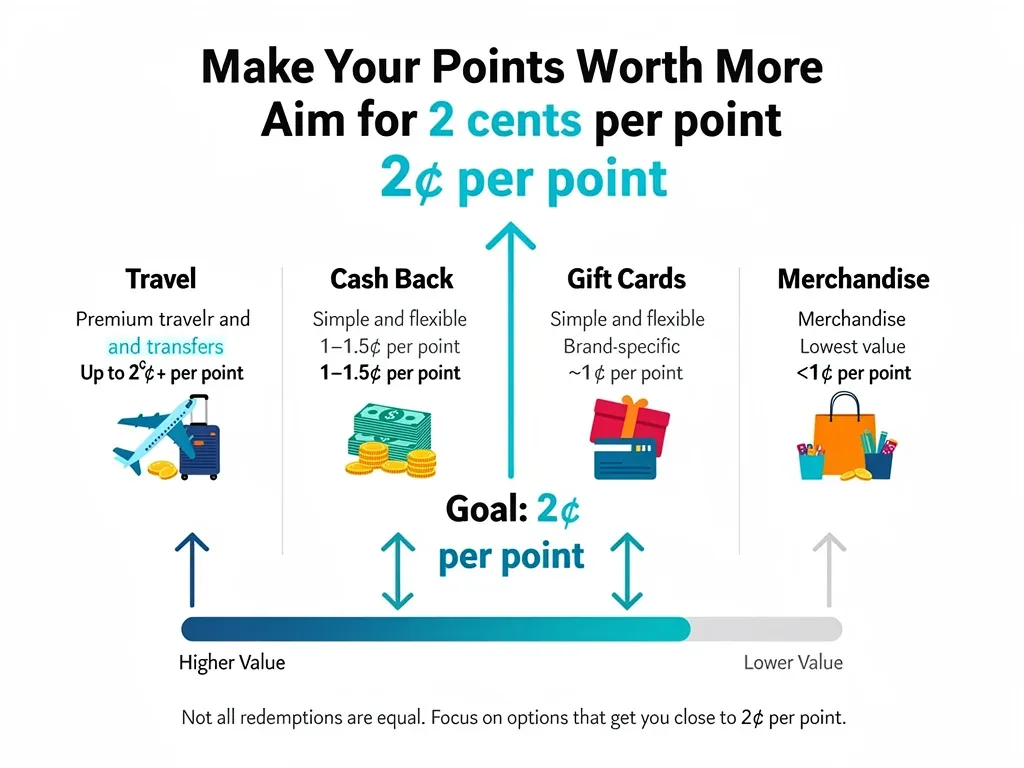
Premium Travel Can Produce High Redemption Values
Business-class and first-class tickets can sometimes generate high cents-per-point calculations because their comparable cash prices are expensive.
That does not automatically make them the best use of rewards for every traveler, especially when those cash prices would never be paid.
Redemption value should therefore reflect both mathematical value and how much personal utility the trip actually provides.
Look for Airline Award Opportunities
Partner awards can occasionally require fewer miles than booking the same itinerary through the airline operating the flight.
Finding those opportunities requires checking multiple loyalty programs, travel dates, cabins, routes, and sometimes departure airports.
Award pricing can change frequently, particularly in programs using dynamic pricing instead of traditional fixed award charts.
Check Taxes and Carrier Surcharges
A low mileage requirement can look attractive until substantial carrier-imposed surcharges are added to the final award price.
Those cash charges should be subtracted when calculating how much real value the points are actually replacing.
Comparing partner programs can sometimes reveal another booking option with similar mileage requirements but considerably lower additional charges.
Hotel Redemptions Require Their Own Benchmark
Hotel currencies often have lower average values per point than transferable credit card rewards or some airline miles.
That does not make them poor rewards because hotel programs commonly issue points at different rates and quantities.
A realistic benchmark should therefore be based on the specific hotel currency rather than automatically requiring two cents per point.
Compare Award Nights With Cash Prices
Hotel redemption value can improve during expensive travel periods when the points price rises less dramatically than the equivalent cash rate.
Conversely, inexpensive nights may be better purchased with cash when the points requirement remains relatively high.
Always compare both options before booking because dynamic award pricing can make the better choice change from one date to another.
Use Free-Night Benefits Carefully
Some loyalty programs or credit cards provide free-night certificates or benefits for longer award stays under specific conditions.
These benefits can lower the effective points cost of a trip when the chosen property qualifies under the applicable rules.
Availability, certificate limits, resort charges, and expiration dates should all be checked before assigning a high value to the benefit.
Dynamic Pricing Has Changed Rewards Strategy
Many loyalty programs increasingly connect award prices to demand, cash prices, travel dates, or other dynamic factors.
This makes fixed assumptions about point value less reliable because the same route or hotel can require different amounts on different dates.
Flexibility becomes more valuable when members can compare several dates and avoid the most expensive award periods.
Flexibility Can Increase Redemption Value
Travelers who can move a trip by several days often have more opportunities to find lower award pricing or better availability.
Comparing nearby airports or different partner programs can further expand the range of redemption choices available.
This does not guarantee exceptional value, but flexibility generally improves the chances of finding an award above a program's typical benchmark.
Cash Prices Can Change the Calculation
When airfare or hotel prices fall sharply, using points may provide less value because the comparable cash expense becomes smaller.
During expensive periods, the same number of points can generate a much stronger mathematical return if award pricing remains reasonable.
Checking both prices immediately before redemption prevents outdated assumptions from determining how rewards are used.
Protect Points From Devaluation
Loyalty programs control their currencies and can change award prices, transfer relationships, redemption rules, or other program features.
This makes points different from cash savings because their future purchasing power is not fixed or guaranteed.
Holding enormous balances without a planned use can therefore expose consumers to unnecessary devaluation risk over time.
Earn With a Redemption Goal
A useful rewards strategy begins with a likely trip or redemption instead of accumulating points indefinitely without a clear objective.
Knowing the destination and approximate travel period helps determine which transferable currency or loyalty program deserves priority.
This approach reduces the chance of earning heavily in a program that later offers limited value for the travel actually desired.
Diversification Can Reduce Program Risk
Flexible rewards held with major credit card programs can preserve options until a specific airline or hotel transfer is needed.
Maintaining every balance in one airline or hotel program creates greater exposure if that program changes its redemption structure.
Diversification should remain manageable, however, because spreading rewards across too many small balances can also make them difficult to use.
Credit Card Bonuses Need Context
Welcome bonuses can produce a large rewards balance quickly, but their value depends on whether the card fits broader financial needs.
Annual fees, spending requirements, interest charges, and card benefits should all be considered before focusing on the advertised point total.
Rewards rarely justify carrying credit card debt because interest charges can quickly exceed the value obtained from points or miles.
Evaluate Annual Fees Against Real Benefits
A premium card may include travel credits, lounge access, insurance benefits, elite perks, or stronger transfer opportunities.
Those features have value only when the cardholder actually uses them instead of assigning them their full advertised price automatically.
Compare the realistic annual benefit with the fee before keeping a card solely because its rewards currency appears valuable.
Match Bonus Categories to Normal Spending
Bonus categories are most useful when they reward purchases that already form part of the household's normal budget.
Increasing spending solely to earn additional points can undermine the financial value of even a strong rewards program.
The most sustainable approach earns additional rewards from planned spending rather than allowing rewards incentives to drive unnecessary purchases.
Cash Back Can Still Be the Better Redemption
A lower theoretical cents-per-point value does not always mean a redemption is financially inferior for a particular consumer.
Cash back provides flexibility, simplicity, and certainty without requiring award searches, transfer partners, or specific travel dates.
Consumers who do not value premium travel may reasonably prefer predictable cash value over a complicated redemption with higher theoretical valuation.
Personal Value Matters
A business-class ticket priced at thousands of dollars may produce an impressive calculation even if the traveler would never purchase it.
In that situation, comparing the award against an unrealistic cash alternative can exaggerate the practical value of the points.
A strong redemption should deliver something genuinely useful rather than simply producing the highest possible numerical cents-per-point result.
Opportunity Cost Should Be Included
Using 100,000 points for one redemption means those rewards are no longer available for several smaller trips or other purchases.
Consumers should compare alternative uses before spending a large balance on a single high-value booking.
This opportunity-cost approach prevents an attractive headline valuation from overshadowing other rewards that may provide greater overall utility.

Monitor Program Changes in 2026
The rewards landscape can change rapidly when issuers adjust transfer ratios, airlines modify award pricing, or hotels revise redemption structures.
Changes during 2026 already demonstrate that assumptions based on previous years may no longer describe the value available today.
Checking official program terms before transferring or redeeming rewards is therefore an essential part of any current strategy.
Transfer Ratios Can Change
Transferable currencies are valuable partly because of their partners, but ratios can vary by issuer, card product, and loyalty program.
A partner that once provided a one-to-one conversion may become less attractive if the transfer rate is reduced.
Always calculate the value after applying the current transfer ratio rather than relying on older articles or previous booking experiences.
Point Valuations Are Estimates
Published point valuations are useful benchmarks based on observed redemption opportunities, but they are not guaranteed cash values.
Different analysts can assign different valuations because their methodologies, datasets, and assumptions about typical redemptions are not identical.
Your own redemption can therefore produce a result above or below any published estimate depending on the specific booking.
Use Technology Without Giving Up the Math
Award search tools can simplify the process of checking availability across multiple airlines and loyalty programs.
They can save time when a traveler has flexible dates or several transferable currencies available for the same destination.
However, search results should still be verified directly with the loyalty program before transferring points or making final decisions.
Alerts Can Help Find Availability
Some travel tools allow users to monitor specific routes or dates and receive alerts when reward availability changes.
This can be useful for premium cabins or popular destinations where award seats may appear unpredictably.
An alert does not guarantee the seat will remain available, so travelers should verify inventory before initiating irreversible point transfers.
Personalized Recommendations Need Verification
Financial and travel platforms increasingly use algorithms to suggest cards, loyalty programs, transfers, and potential redemptions.
These recommendations can narrow the search but may not account for every preference, fee, restriction, or alternative available.
The final decision should still rely on current program terms and a direct comparison between points and cash.
Key Strategy | Why It Matters |
|---|---|
Calculate Value | Shows the actual cents received from each point. |
Flexible Points | Provides access to multiple potential transfer partners. |
Transfer Bonuses | Can reduce the number of original points required. |
Award Flexibility | Improves access to favorable dates and pricing. |
Program Monitoring | Helps consumers react to changes and devaluations. |
Frequently Asked Questions About Maximizing Rewards Redemption
What does two cents per point mean?
It means 10,000 points provide approximately $200 in comparable value after accounting for relevant taxes, fees, and other cash charges.
Should every rewards program provide two cents per point?
No. Typical values vary significantly by currency, and many major airline, hotel, and credit card programs have benchmarks below two cents.
Are transferable points always worth more?
No. They offer additional options, but the value ultimately depends on transfer ratios, partner award pricing, availability, and the redemption selected.
Should I transfer points when a bonus appears?
Usually only when you have identified a useful redemption, confirmed availability, and calculated that the transfer provides appropriate value.
Can premium flights provide more than two cents per point?
Yes, some premium-cabin awards can exceed that level, but high cash prices can also make the calculated value appear unusually large.
Is cash back a poor use of rewards?
Not necessarily. Cash back can be preferable for consumers who value simplicity, flexibility, and predictable value more than premium travel.
Conclusion
Maximizing rewards redemption in 2026 depends on understanding the value of each currency instead of chasing one universal benchmark.
Transfer partners, bonuses, award availability, cash prices, fees, and program changes can all influence the final value received.
Calculating each redemption before transferring or spending points remains the most reliable way to decide whether the opportunity is genuinely worthwhile.