Maximize Rewards: 1.5x Point Value This Quarter
Advertisements
Latest developments on the smart way to use rewards portals in 2026 show that consumers can sometimes earn additional rewards on purchases, but there is no universal promotion guaranteeing a 1.5x point value on every purchase this quarter.
Shopping portals, credit-card rewards, merchant offers, and redemption bonuses operate under different rules, making it important to distinguish additional earnings from increased point value.
The most effective approach is to compare the portal offer, the credit card's normal earning rate, purchase eligibility, and eventual redemption options before deciding where to shop.
Understanding Rewards Portals in 2026
Rewards portals are online platforms that direct shoppers to participating merchants and provide additional points, miles, cash back, credits, or other rewards on eligible purchases.
Programs can be operated by credit-card issuers, airlines, hotels, cash-back companies, or independent shopping platforms, and the reward structure varies considerably between them.
An offer should therefore be evaluated according to its specific terms rather than assuming that all portals provide the same earning rate or redemption value.
There Is No Universal Guaranteed 1.5x Offer
No broadly available rewards-portal program currently guarantees that every eligible purchase across all participating portals receives a universal 1.5x point value during this quarter.
Individual merchants and programs may offer 1.5x, 2x, 5x, 10x, percentage cash back, targeted bonuses, or other temporary rewards at different times.
Those rates can change without notice and may be personalized, capped, limited to particular merchants, or unavailable to some customers.
Why the 1.5x Claim Can Be Confusing
A 1.5x earning rate generally means earning 1.5 points for each eligible dollar spent when an offer is structured that way.
A 1.5x redemption value means existing points provide 50% more purchasing power for a particular redemption compared with a specified baseline.
Those concepts are not interchangeable, and a program can offer one without offering the other.
Earning rate: How many points, miles, or rewards you receive from a purchase.
Redemption value: What accumulated rewards are worth when used.
Portal bonus: Additional rewards offered for shopping through a particular link or platform.
How Shopping Portal Rewards Actually Work
A shopping portal typically receives a commission when an eligible customer follows its link and completes a qualifying purchase with a participating merchant.
The portal may share part of that commission with the customer through points, miles, cash back, statement credits, or proprietary rewards.
Eligibility depends on merchant terms, product exclusions, purchase tracking, account status, and any requirements stated when the offer is activated.
Capital One Offers and Capital One Shopping Are Different
Capital One Offers allows eligible Capital One cardholders to activate merchant-specific offers that can generate rewards or statement credits according to each deal.
Capital One Shopping is a separate shopping service whose rewards can generally be exchanged for eligible e-gift cards rather than withdrawn as cash.
Because the platforms work differently, consumers should not assume that a percentage shown in one service represents the same type of reward offered through the other.
Targeted Offers Matter
Some shopping promotions are personalized to a particular account and may not appear for another customer using the same platform.
Capital One Shopping, for example, states that certain bonus offers can be limited in availability, expire, and be tied specifically to an individual account.
This makes it inaccurate to describe targeted promotions as universal opportunities available to every rewards-program member.
Understanding Earning Rates vs. Point Value
Earning additional points during a transaction and increasing the value of points at redemption are separate parts of a rewards strategy.
A shopping portal usually affects what you earn when purchasing, while a redemption program determines what those accumulated points are worth later.
The distinction matters because a large earning multiplier can still produce modest value if the rewards have limited or low-value redemption options.
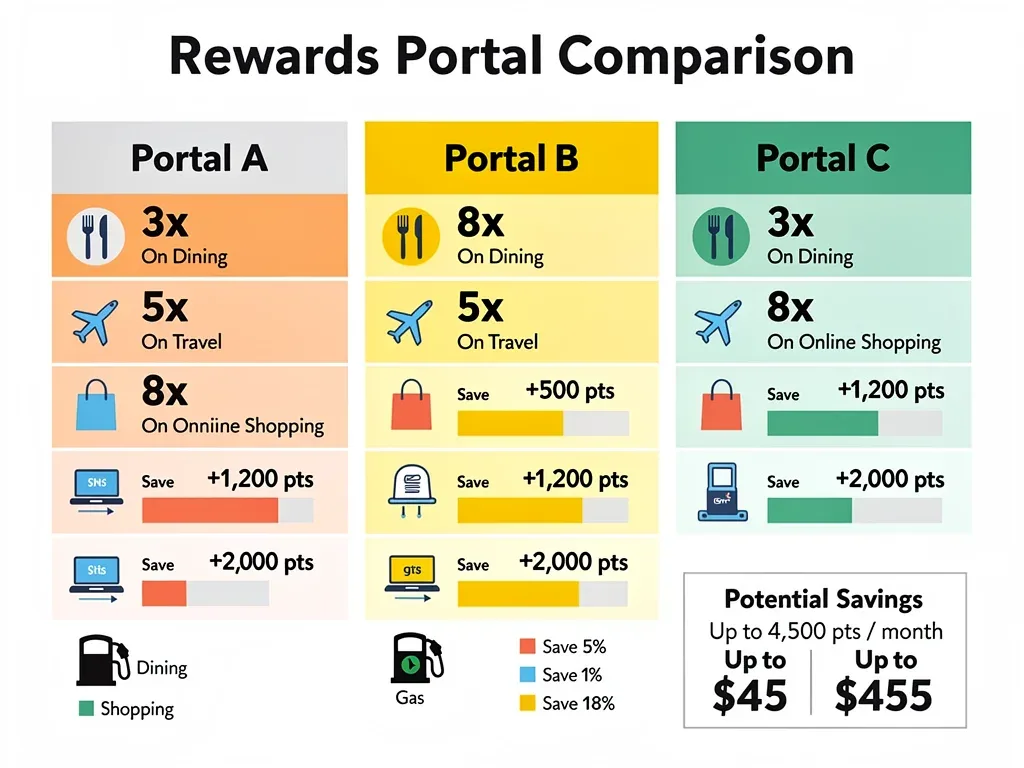
A Simple Earning Example
Suppose a credit card normally earns 2 points per dollar and a separate shopping portal offers 3 additional points per dollar at a particular retailer.
If both rewards apply independently under their respective terms, a $100 eligible purchase could generate 200 card points plus 300 portal points.
That does not necessarily mean the transaction earned “5x value,” because the two reward currencies may have different redemption values.
Chase Points Boost Is a Redemption Example
Chase's current Points Boost program illustrates how redemption value differs from earning rate.
Eligible Chase cards can receive enhanced point value on select hotel or flight bookings through Chase Travel, with the exact boost determined by the card and available offer.
This does not turn every purchase into a 1.5x shopping-portal transaction and should not be described as a universal rewards multiplier.
How to Stack Rewards Correctly
Some purchases can generate rewards from both the credit card used for payment and the portal through which the shopping session began.
This can create useful stacking opportunities, but only when the individual terms of both programs allow the transaction to qualify.
Consumers should calculate each reward separately rather than simply adding multipliers that may represent different currencies or valuation systems.
An Example of Legitimate Stacking
Imagine a card earning 2 points per dollar on online purchases while a portal offers 5% cash back at the same retailer.
A qualifying $500 purchase could potentially earn 1,000 card points plus $25 in portal cash back if both offers track and all terms are satisfied.
The total economic benefit depends on the value eventually received from those 1,000 card points rather than on describing the transaction as a simple “7x” return.
When Offers May Not Stack
Using a coupon code that was not supplied or approved by the shopping portal can sometimes make a purchase ineligible for portal rewards.
Another shopping extension may also interfere with tracking when it replaces or modifies the original affiliate attribution before checkout.
The safest approach is to review the portal's exclusions and complete the purchase according to its stated tracking instructions.
Choosing the Best Portal for a Purchase
Portal rates can vary substantially even when several programs link to the same retailer.
One portal may offer airline miles, another may offer cash back, and a credit-card issuer may provide a merchant-specific statement-credit offer.
The best option depends on the reward amount, currency value, restrictions, and how the consumer intends to use those rewards.
Compare More Than the Headline Multiplier
A 10x offer in a low-value or restrictive reward currency is not automatically superior to a smaller cash-back offer.
Consumers should consider the expected redemption value, minimum redemption requirements, expiration policies, and whether the purchase itself is eligible.
It is also worth checking whether taxes, shipping, gift cards, subscriptions, or selected product categories are excluded from rewards.
Maximizing Redemption After Earning
Accumulating a large balance is only part of a rewards strategy because the final return depends on how those rewards are redeemed.
Cash back provides a relatively straightforward value, while transferable points and airline miles can vary considerably depending on the redemption.
Merchandise and gift-card redemptions can also produce different values, so consumers should compare alternatives rather than assume one category is always best.
Travel Redemptions Can Vary Widely
Transferring points to an airline or hotel program can sometimes produce attractive value, but award pricing and availability can change frequently.
Premium-cabin flights are sometimes cited as high-value redemptions, but finding suitable award inventory may require flexibility with dates, routes, and programs.
Aspirational travel should therefore be treated as one possible redemption strategy rather than a guaranteed method of maximizing points.
Cash Back Offers Simpler Valuation
Cash back is usually easier to evaluate because a stated dollar reward has a clear nominal value.
This simplicity can be useful for consumers who prefer flexibility instead of navigating airline, hotel, or transfer-partner programs.
The best redemption choice depends on personal goals rather than a universal rule that travel is always more valuable than cash.
Monitoring Rewards Program Changes
Shopping portal rates and merchant offers can change frequently, sometimes within days or even hours.
Programs may also update redemption values, eligible retailers, exclusions, or requirements without maintaining the same promotional structure indefinitely.
Checking the current offer immediately before purchasing is therefore more reliable than relying on an older rewards chart or article.
Use Official Offer Details
Card issuers and shopping portals generally display the applicable terms when an offer is activated or selected.
Those terms should be treated as the primary reference for spending requirements, eligible products, expiration dates, and reward calculations.
Articles and comparison sites can help identify opportunities, but the current official offer ultimately determines eligibility.
Check the offer immediately before purchasing.
Review merchant exclusions and spending requirements.
Save relevant offer details until the reward posts.
Tracking Purchases and Missing Rewards
Portal rewards may not appear immediately after a purchase because merchants often need time to validate transactions.
Capital One Shopping states that rewards can take approximately 30 to 90 days to post after an eligible purchase, and travel-related rewards may take longer.
Maintaining purchase confirmations and basic offer information can be useful if a qualifying reward does not eventually appear.
Avoid Common Tracking Problems
Start the shopping session from the intended portal and activate the offer before completing the transaction.
Avoid switching between multiple rewards extensions or unrelated promotional links during checkout because they may interfere with attribution.
Do not automatically clear cookies immediately before or during every portal transaction, since tracking itself frequently relies on browser cookies and related technologies.
Comparing Portal Bonuses With Credit Card Categories
A shopping portal should be considered alongside the card's ordinary earning structure rather than as a replacement for it.
A credit card may already offer enhanced rewards for travel, dining, groceries, online shopping, or another spending category.
The strongest combination is generally the one that captures an eligible portal reward while also using an appropriate payment method without adding unnecessary costs.

Higher Multipliers Are Not Always Better
A card offering 5x points in a particular category may be valuable, but the actual return depends on what those points are worth when redeemed.
A lower cash-back percentage can sometimes provide comparable or better practical value if the alternative points have limited redemption options.
Calculating the expected dollar value provides a clearer comparison than focusing solely on the largest multiplier shown on screen.
Avoid Spending More Just to Earn Rewards
Rewards provide value only when the underlying purchase makes financial sense independently of the points or cash back earned.
Buying unnecessary products to reach a bonus threshold can easily cost more than the resulting reward is worth.
The same principle applies to carrying credit-card debt, where interest charges can overwhelm the value of points earned from spending.
Pay Attention to Credit Card Interest
Rewards cards can carry substantial annual percentage rates when balances are not paid according to the account terms.
A few percentage points of rewards cannot offset months of high credit-card interest on a revolving balance.
For consumers using rewards credit cards, paying eligible balances in full when possible is generally more important than maximizing a portal multiplier.
Examples of How Portal Rewards Can Work
The following examples illustrate reward mechanics rather than representing guaranteed results from current promotions.
Actual portal rates, credit-card earnings, exclusions, and redemption values must be checked at the time of each transaction.
This distinction avoids presenting hypothetical reward scenarios as verified customer success stories.
Example: Everyday Online Purchase
Suppose a shopper needs a $200 household item and finds a portal offering 4% back at the selected merchant.
If the purchase qualifies, the portal component would represent $8 in rewards before considering whatever rewards the payment card separately earns.
The shopper should still compare the merchant's total price because paying more simply to access a portal reward may eliminate the benefit.
Example: Larger Planned Purchase
Suppose a customer already intends to spend $1,500 on an eligible appliance and finds a portal offering 5% back.
If all terms are satisfied and the transaction tracks correctly, the portal component could represent $75 in rewards.
That can be meaningful, but price, warranty, return policy, financing costs, and merchant reliability should still influence the purchase decision.
Limitations of Rewards Portals
Portal offers may contain exclusions for particular brands, products, gift cards, taxes, shipping costs, or other transaction components.
Returns and cancellations can also result in pending rewards being reduced or removed after a merchant reviews the transaction.
Consumers should therefore avoid treating pending portal rewards as final until the program confirms them.
Promotions Are Not Permanent
Rewards rates can rise during seasonal campaigns and later return to lower levels.
A targeted bonus may also disappear after activation deadlines or after a customer has used the offer once.
Instead of planning unnecessary purchases around a temporary promotion, use portal bonuses primarily when they overlap with purchases that were already planned.
Key Concept | How It Actually Works |
|---|---|
Universal 1.5x Promotion | No verified universal promotion guarantees 1.5x value on all rewards-portal purchases this quarter. |
Portal Earning | Rates vary by portal, merchant, account, eligibility, and current promotion. |
Point Value | Redemption value is separate from the number of points earned during a purchase. |
Reward Stacking | Card and portal rewards may sometimes be earned together when both programs' terms allow it. |
Best Practice | Compare price, portal reward, card earnings, exclusions, and redemption value before purchasing. |
Frequently Asked Questions About Rewards Portals
Is there a guaranteed 1.5x point value on every portal purchase this quarter? ▼
No verified universal offer guarantees 1.5x value across all rewards portals and purchases. Merchant rates and targeted promotions vary by program, account, and transaction.
Is earning 1.5x the same as getting 1.5x point value? ▼
No. An earning multiplier describes how many points you receive, while point value describes what those points are worth when redeemed.
Can shopping portal rewards stack with credit card rewards? ▼
They often can because the portal and payment card may reward different parts of the transaction, but eligibility always depends on the terms of both offers.
Can outside coupon codes affect my portal rewards? ▼
Yes. Some portals exclude purchases made with unauthorized coupon codes or other affiliate links, so the offer terms should be checked before checkout.
Are rewards credited immediately? ▼
Not necessarily. Merchant validation can take weeks, and some programs state that rewards may take 30 to 90 days or longer to become available.
What This Means
The smart way to use rewards portals in 2026 is not to chase a nonexistent universal 1.5x guarantee, but to compare the actual reward attached to each planned purchase.
Consumers can improve their results by combining eligible credit card rewards with portal earnings, monitoring program changes, and checking whether rewards are approaching expiration where applicable.
The key is to separate earning rate from redemption value, verify current terms before buying, and avoid spending more or carrying expensive debt simply to earn additional rewards.