Maximize Rewards: Link Programs for 10% Back
Advertisements
Are You Leaving Points on the Table? How to Link Rewards Programs for More Value is a useful question for consumers juggling credit card rewards, airline miles, hotel points, retailer loyalty accounts, and shopping portals. Connecting eligible accounts can create additional earning and redemption opportunities, but it does not automatically produce an extra 10% return.
In some purchases, a card reward, retailer offer, and shopping-portal rebate can legitimately stack and produce double-digit value. In other situations, program rules, excluded coupons, transfer ratios, booking channels, or spending caps can substantially reduce the return.
The strongest rewards strategy in 2026 is therefore not to chase a fixed percentage, but to understand which programs can actually be linked, which benefits can coexist, and whether the combined value exceeds the simplest available redemption.
Understanding the Rewards Landscape
The U.S. rewards market includes several fundamentally different systems: credit card points, cash-back programs, airline miles, hotel points, retailer loyalty currencies, dining rewards, and shopping portals.
These programs should not be treated as interchangeable because they have different earning rules, expiration policies, transfer restrictions, redemption values, and account-linking requirements.
For consumers following broader loyalty program trends, the first step is identifying what type of reward each account actually provides before trying to combine them.
Three Different Actions Are Often Confused
Linking usually means connecting one account to another so a program can recognize an eligible card, loyalty number, or partner account.
Transferring means moving points from one eligible rewards currency into another participating loyalty program, usually according to a defined conversion ratio.
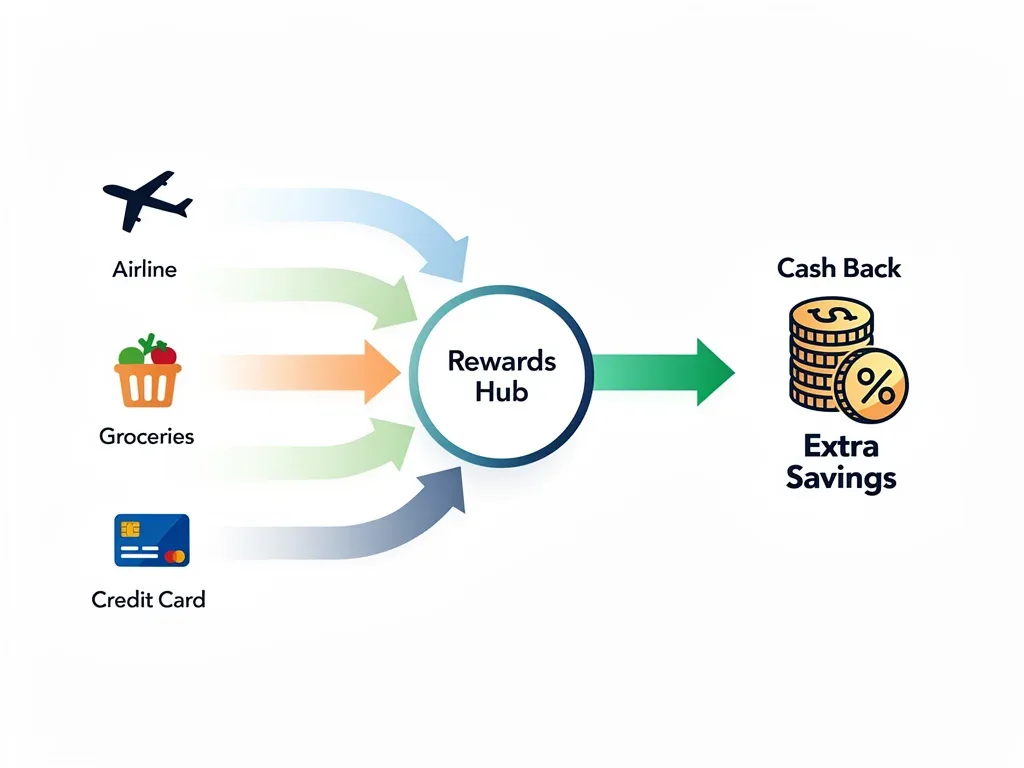
Stacking means earning more than one compatible benefit on the same purchase, such as credit card rewards plus an eligible shopping-portal rebate.
Can You Really Get an Extra 10% Back?
An additional 10% return is possible on selected transactions, especially when a retailer or portal temporarily offers a high cash-back rate and the payment card earns rewards at the same time.
It is not a standard benefit of connecting rewards accounts, and the percentage can vary significantly by merchant, card, category, promotion, spending cap, and redemption method.
A more accurate strategy is to calculate the return transaction by transaction rather than assume every linked purchase will earn 10% or more.
A Realistic Stacking Example
Suppose an eligible shopping portal is offering 8% cash back at a retailer and the credit card used for the transaction earns 2% back on the purchase.
If the portal terms allow the transaction and no excluded coupon or payment method is used, the combined nominal return could reach approximately 10% before considering taxes, fees, caps, or differences in reward valuation.
This is a promotional scenario rather than a guaranteed formula, and portal rates can change frequently.
Credit Card Rewards and Shopping Portals Can Sometimes Stack
Shopping portals are one of the clearest examples of legitimate rewards stacking because the portal may earn a referral commission from the retailer while the credit card separately earns rewards from the card issuer.
Rakuten currently states that its Cash Back can stack with credit card rewards and eligible coupons offered through its platform, although Cash Back rates vary by merchant.
This type of combination can increase the effective return without requiring the consumer to transfer points between loyalty programs.
Card-Linked Offers Work Differently
Some in-store and dining rewards require consumers to register or link an eligible payment card before completing the purchase.
Rakuten, for example, currently offers card-linked Cash Back at participating restaurants and selected in-store merchants, subject to its terms and available offers.
That is different from transferring credit card points to an airline because the linked card is being used to identify an eligible transaction rather than move rewards between programs.
Credit Card Points Can Be Linked to Travel Partners
Several major U.S. credit card rewards programs allow eligible members to link airline or hotel loyalty accounts and then transfer points to participating partners.
American Express Membership Rewards, Chase Ultimate Rewards, and Capital One Miles all currently provide transfer options for eligible accounts, although the available partners and conversion ratios differ.
A points transfer strategy should therefore begin with the current issuer terms rather than an old list of partners.
American Express Membership Rewards
Eligible American Express Card Members can link Membership Rewards to participating frequent-flyer and hotel loyalty accounts and transfer points into those programs.
American Express advises members to verify reward availability before transferring because transfers are final and transferred points become subject to the partner program's rules.
The company also notes that the value of Membership Rewards points varies according to how they are redeemed, so transferring is not automatically the highest-value option.
Chase Ultimate Rewards
Eligible Chase Ultimate Rewards cardholders can transfer points to participating airline and hotel partners as well as use points through Chase Travel.
Many Chase partners use a 1:1 transfer ratio, but current terms must be checked because partner ratios can change and may differ among cardholders.
In 2026, for example, Chase published a different World of Hyatt conversion ratio for certain accounts, illustrating why old assumptions about transfer values can quickly become outdated.
Capital One Miles
Capital One allows eligible travel-rewards cardholders to transfer miles to participating airline and hotel loyalty programs.
Most current partners use a 1:1 conversion ratio, but Capital One also lists partners with ratios such as 2:1.5, 5:3, 2:1, and 1:2.
The ratio therefore needs to be evaluated together with the expected redemption value rather than assuming that a larger number of destination points necessarily represents a better deal.
Transfer Ratios Do Not Tell the Whole Story
A 1:1 transfer sounds simple because 1,000 credit card points become 1,000 airline or hotel points, but equal quantities do not mean equal monetary value.
Different loyalty currencies can produce very different redemption values depending on the flight, room, date, fees, availability, and program rules.
Before transferring, compare the actual award cost with the cash price and with other redemption options available through the original credit card program.
Do Not Transfer Speculatively Without a Plan
Many point transfers cannot be reversed after they are completed.
American Express explicitly advises checking award availability before transferring points because completed transfers are final.
A safer approach is to locate the intended redemption first, confirm availability and transfer requirements, and only then move the points if the value makes sense.
Transfer Fees Can Reduce Value
Some transfers can involve fees, meaning the nominal point conversion does not capture the full cost of the transaction.
American Express currently states that transfers of Membership Rewards points to U.S. airline frequent-flyer programs can incur an excise-tax offset fee of $0.0006 per point, capped at $99 per transfer.
That does not make every such transfer unattractive, but the fee should be included when calculating the true value of the redemption.
Compare the Complete Redemption Cost
A travel award can also include carrier surcharges, taxes, booking fees, or other charges imposed by the loyalty program.
Those costs should be compared with the cash price of the ticket or hotel stay rather than evaluating only the number of points required.
A lower points price can still represent poor value when significant cash charges are added.
Travel Rewards Do Not Always Stack the Way You Expect
The original strategy of simultaneously earning credit card points, airline miles, hotel points, portal rewards, and elite benefits on the same travel booking is not universally available.
Airline tickets may still earn frequent-flyer credit when booked through many eligible channels, but hotel loyalty programs often impose restrictions on points, elite-night credit, or status benefits when rooms are booked through certain third-party travel agencies.
Before using a portal solely for an additional rebate, check whether the booking remains eligible for the airline or hotel benefits you value.
Direct Booking Can Sometimes Be More Valuable
A portal may advertise additional rewards while a direct hotel booking could provide elite benefits, member pricing, qualifying nights, or other advantages.
The better option depends on the monetary value the traveler assigns to those benefits and the actual price difference.
This is why rewards optimization requires comparing total value rather than simply choosing whichever channel advertises the largest number of points.
Shopping Portals Require Careful Tracking
Online shopping portals generally require users to activate an offer or begin the shopping session through the portal before completing an eligible purchase.
Cash-back rates can change without becoming permanent features, and individual merchants may have exclusions involving product categories, gift cards, coupon codes, or other conditions.
Always read the current merchant terms before using a large cash-back percentage in your expected return calculation.
Keep Evidence of Larger Portal Purchases
For significant purchases, it can be useful to retain the order confirmation and information about the advertised portal rate at the time of purchase.
Tracking systems do not always post rewards immediately, and some transactions may require investigation when the expected rebate does not appear.
Consumers should also distinguish between pending rewards and rewards that have become payable under the portal's terms.
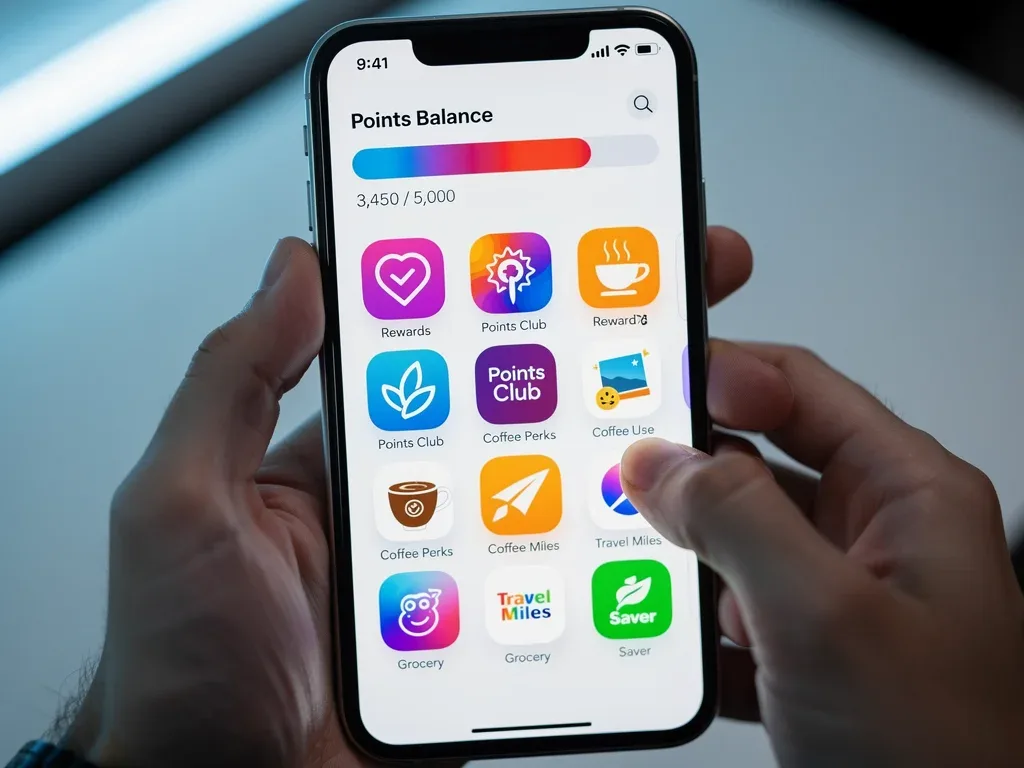
Rewards Aggregators Help Track Accounts, Not Automatically Merge Them
Tools such as AwardWallet can simplify organization by displaying balances, expiration information, account details, and travel-related rewards across many loyalty programs.
AwardWallet currently states that it supports more than 600 loyalty programs and can provide notifications when points or benefits are approaching expiration.
However, tracking multiple balances in one interface does not mean those currencies have been merged into a single transferable rewards balance.
What AwardWallet Actually Does
AwardWallet can track airline miles, hotel points, credit card rewards, elite status, certificates, and other account information supported by its platform.
It can also provide expiration reminders and help users see their rewards information in a consolidated dashboard.
AwardWallet itself states that it cannot add miles or points to a user's loyalty program; those transactions remain controlled by the underlying program.
Points.com Is Not Simply a Universal Rewards Dashboard
The original article grouped Points.com with rewards tracking applications, but that description is incomplete.
Points operates loyalty-commerce infrastructure used by participating programs for activities such as buying, gifting, transferring, or exchanging loyalty currencies when those programs permit it.
Available exchanges and ratios depend on the specific loyalty program, so consumers should not assume that any two accounts can be connected through Points.
Exchange Ratios Can Be Very Different
One current Points-powered Choice Privileges exchange page, for example, lists different ratios depending on the airline program receiving the points.
That illustrates why an exchange should be valued using the destination currency and intended redemption rather than just the number of points shown after conversion.
Moving points solely for consolidation can destroy value when the exchange ratio is unfavorable.
Expiration Rules Are Program Specific
Some loyalty currencies expire after a defined period of inactivity, others expire after a fixed period, and some do not expire while the account remains open and in good standing.
There is no single expiration rule that applies across credit cards, airlines, hotels, and retailers.
A tracking service can provide reminders, but the official program terms should remain the final source for confirming whether points actually expire.
Do Not Create Activity Just for the Sake of Activity
If a program requires qualifying activity to extend expiration, verify which transactions actually count before spending money solely to preserve a small balance.
In some cases the cost of generating activity can exceed the realistic value of the points being protected.
Reward balances should be treated according to their usable value rather than simply accumulated indefinitely.
Security Matters When Connecting Loyalty Accounts
Rewards accounts can hold significant economic value, particularly when they contain transferable points or large airline and hotel balances.
Use unique passwords and enable multifactor authentication whenever a loyalty program or tracking service provides it.
Consumers should also verify exactly what permissions they are granting when connecting a third-party service to an account.
Understand What Data a Tracker Can Access
Rewards tracking can require sharing account data or authorizing access to loyalty information.
AwardWallet states that its service uses security measures including encryption and multifactor authentication, but users should still evaluate their own comfort with connecting external services.
A consumer who does not want to connect accounts can maintain a manual spreadsheet or periodic balance checklist instead.
Card-Linked Rewards Can Create Duplicate Enrollment Issues
Some dining and card-linked rewards networks depend on registering a specific payment card with their programs.
In certain ecosystems, the same card cannot earn through multiple programs built on the same underlying network at the same time, or enrollment in one can interfere with another.
This makes it important to read enrollment terms before connecting the same card to several seemingly independent offers.
More Links Do Not Automatically Mean More Rewards
The objective is not to connect every possible account to every possible service.
Some combinations are complementary, while others are mutually exclusive or create no additional earning opportunity.
Reward optimization therefore depends on compatible program rules rather than the sheer number of linked accounts.
How to Calculate Your Real Rewards Rate
The simplest approach is to estimate each compatible benefit as a percentage of the purchase price and then add only rewards that can actually be earned together.
If a $100 eligible purchase produces $5 of portal Cash Back and $2 of credit card rewards, the nominal combined return is $7, or 7%.
If the card earns flexible points rather than cash back, the calculation should use a reasonable redemption value instead of automatically treating every point as one cent.
Separate Nominal Earnings from Redemption Value
Earning five points per dollar does not automatically mean earning 5% back.
The actual return depends on how much value each point produces when redeemed and whether the redemption requires additional fees or restrictions.
This distinction is particularly important for transferable travel currencies whose value can vary substantially between redemptions.
A Simple Rewards-Stacking Checklist
Before making a purchase, identify the strongest card earning rate, check whether a portal or card-linked offer is available, and confirm that the merchant terms permit the combination.
For travel redemptions, compare paying cash, booking through the card issuer's portal, and transferring points to an airline or hotel partner before moving any currency.
Finally, calculate the benefit after accounting for fees, redemption value, lost elite benefits, spending caps, and any additional purchasing requirements.
Check the card's current earning category.
Look for eligible merchant or shopping-portal offers.
Confirm whether external coupon codes are permitted.
Verify transfer ratios before moving points.
Check award availability before irreversible transfers.
Compare total value, not simply the number of points earned.
When a 10% Return Is Actually Plausible
Double-digit returns are most plausible when a temporary shopping portal or merchant offer already provides a substantial percentage and the payment card adds a separate reward.
For example, an 8% eligible portal offer combined with a card earning an effective 2% can produce approximately 10% in nominal value if both rewards post successfully.
The same calculation should not be used as a baseline expectation for everyday spending because portal and merchant promotions can fluctuate substantially.
Promotional Returns Are Not Permanent Returns
A merchant showing 10% Cash Back today could offer a materially different rate later.
Card bonus categories can also rotate, require enrollment, impose spending caps, or change under issuer terms.
Optimization therefore works best when consumers verify offers at the time of purchase rather than relying on a static rewards chart.
Do Not Spend More Just to Earn Rewards
A rewards strategy only creates genuine economic value when the underlying purchase would otherwise make sense.
Spending $100 unnecessarily to earn $10 in rewards still results in a net cash outflow of approximately $90.
Likewise, carrying high-interest credit card debt can easily erase the value generated by points, miles, or cash back.
Rewards Should Follow the Purchase
The financially stronger sequence is to determine what you need to buy first and then choose the most efficient available payment and rewards combination.
Reversing that process can encourage unnecessary purchases, annual fees, or complicated redemptions solely to justify collecting points.
Rewards work best as a discount on normal spending rather than as the reason for spending.
Program Rules Can Change During 2026
Rewards ecosystems are not static, and partner lists, transfer ratios, redemption options, and promotional offers can change during the year.
American Express, for example, published Membership Rewards program updates in 2026 that included changes to selected redemption options and the removal of Etihad Guest as a transfer option effective June 30.
Checking official program terms immediately before a major transfer or redemption is therefore more reliable than relying on an older rewards guide.
Keep Transfer Partner Lists Current
A strategy built around a particular airline or hotel partner can stop working if the partnership ends or the conversion ratio changes.
Holding flexible rewards until a redemption is identified can preserve optionality compared with transferring speculatively into one travel program.
Once points are moved into a partner program, they are generally governed by that program's rules rather than the original credit card ecosystem.
What Could Change Next in Rewards Programs?
Issuers and loyalty operators continue to invest in personalized offers, card-linked promotions, travel search tools, and easier account integration.
American Express, for example, currently gives eligible Membership Rewards Card Members access to a point.me-powered award search tool that can compare certain transfer-partner flight options.
These developments can make rewards easier to evaluate, but they do not eliminate the need to confirm availability, pricing, and terms before a transfer.
Automation Can Help, but It Cannot Guarantee the Best Deal
Recommendation systems can identify offers or potential redemptions based on available data.
However, reward availability, merchant rates, travel prices, and point values can change between the time an opportunity is identified and the moment a purchase is completed.
The most reliable approach remains automated discovery combined with manual verification of important transactions.
How to Build a Sustainable Rewards Strategy
A simple setup with one or two flexible rewards currencies and a small number of useful loyalty programs can often be easier to manage than dozens of low-balance accounts.
Consumers should prioritize programs that match their actual spending and travel habits instead of joining every promotion that becomes available.
This also reduces the risk of forgetting balances, paying unnecessary fees, or transferring points simply because they are difficult to manage.
Start with Your Largest Spending Categories
Review where your regular spending occurs, such as groceries, dining, travel, fuel, or general purchases, and identify whether your existing cards reward those categories.
Then determine whether any frequently used merchants participate in compatible portals or retailer programs.
This approach focuses effort on transactions that recur throughout the year rather than chasing isolated promotions that provide little total value.
Key Point | What It Really Means |
|---|---|
Linking Programs | Connecting eligible accounts or payment cards; it does not automatically merge all rewards currencies. |
Extra 10% Back | Possible on selected stacked promotions, but not a guaranteed return from linking accounts. |
Point Transfers | Conversion ratios, fees, partners, and redemption values vary and can change. |
Rewards Trackers | Tools such as AwardWallet can consolidate account information but do not automatically combine balances into one currency. |
Best Strategy | Verify compatibility and calculate total value before every major purchase or transfer. |
Frequently Asked Questions About Linking Rewards Programs
Does linking rewards programs automatically give me 10% back?
No. A double-digit return can occur when compatible card rewards and promotional portal or merchant offers stack, but the rate depends on the specific transaction and current terms.
What is the difference between linking and transferring rewards?
Linking connects eligible accounts or cards, while transferring actually converts points from one participating rewards currency into another according to the program's current rules.
Can credit card rewards and shopping portal Cash Back stack?
Sometimes. Rakuten, for example, states that its eligible Cash Back can stack with credit card rewards, but merchant exclusions and individual offer terms still apply.
Should I transfer points as soon as I earn them?
Usually it is safer to identify the intended redemption and verify availability first because many transfers are irreversible and partner programs can change their award pricing or rules.
Is a 1:1 transfer always a good deal?
No. A 1:1 ratio only describes the number of points transferred; the actual value depends on what the destination points can purchase compared with other redemption options.
Can AwardWallet combine all my points into one balance?
No. AwardWallet can track supported loyalty accounts and balances in one dashboard, but the rewards remain inside their respective programs.
Does Points.com let me transfer any rewards program to another?
No. Available buying, gifting, transfer, or exchange options depend on the participating loyalty programs and their individual conversion rules.
Looking Ahead: Maximizing Your Rewards Potential
The strongest way to avoid leaving points on the table is not to connect every rewards account available, but to understand which combinations actually provide additional value on purchases you already intend to make.
Tools, transfer partners, shopping portals, and travel savings opportunities can increase returns, but promotional rates and program rules need to be checked at the time of each transaction.
In 2026, a disciplined rewards strategy means treating “10% back” as an occasional achievable outcome rather than a guaranteed result, while prioritizing compatible stacking, sensible transfers, account security, and redemptions that deliver real value.