Dining Rewards Programs: Earn 4x Points Through 2026
Advertisements
Dining rewards remain an important part of the U.S. credit card market in 2026, but consumers should be careful with claims that all major programs now offer 4X points on restaurant spending.
The most prominent current example is the American Express Gold Card, which earns 4X Membership Rewards points at restaurants worldwide on up to $50,000 in eligible purchases per calendar year.
Other leading cards use different structures, so understanding annual fees, spending caps, merchant eligibility, and redemption value is essential before deciding whether a dining rewards card provides meaningful value.
Understanding the 4X Dining Points Structure
The American Express Gold Card currently awards 4X Membership Rewards points per dollar spent at eligible restaurants worldwide, subject to an annual spending limit.
The 4X rate applies to up to $50,000 in eligible restaurant purchases each calendar year, after which restaurant spending earns 1X for the remainder of that year.
This is an ongoing card benefit under current terms rather than a general temporary promotion scheduled to disappear automatically at the end of 2026.
What Defines a Qualifying Dining Purchase?
Merchant classification matters because rewards are generally determined by how a business is coded in the payment network rather than simply by what the customer purchased.
American Express includes eligible restaurant purchases worldwide and also references takeout and delivery in the United States, but some transactions may not qualify when a restaurant operates inside another establishment.
Bars, nightclubs, cafeterias, caterers, breweries, bakeries, event venues, and some third-party delivery transactions can also be treated differently under the program terms.
Eligible restaurant purchases can earn 4X points.
Takeout and eligible delivery purchases in the U.S. may qualify.
Merchant coding and specific exclusions can affect bonus eligibility.
How Dining Rewards Differ Across Major Cards
The U.S. rewards market does not use one standard dining multiplier, and different cards combine points, cash back, annual fees, credits, and redemption systems in different ways.
For example, the Chase Sapphire Reserve currently earns 3X points on dining at restaurants, while Capital One Savor provides unlimited 3% cash back on dining.
This means consumers should compare total value rather than assuming that a higher numerical multiplier automatically makes one card more rewarding.
Points and Cash Back Are Not Directly Comparable
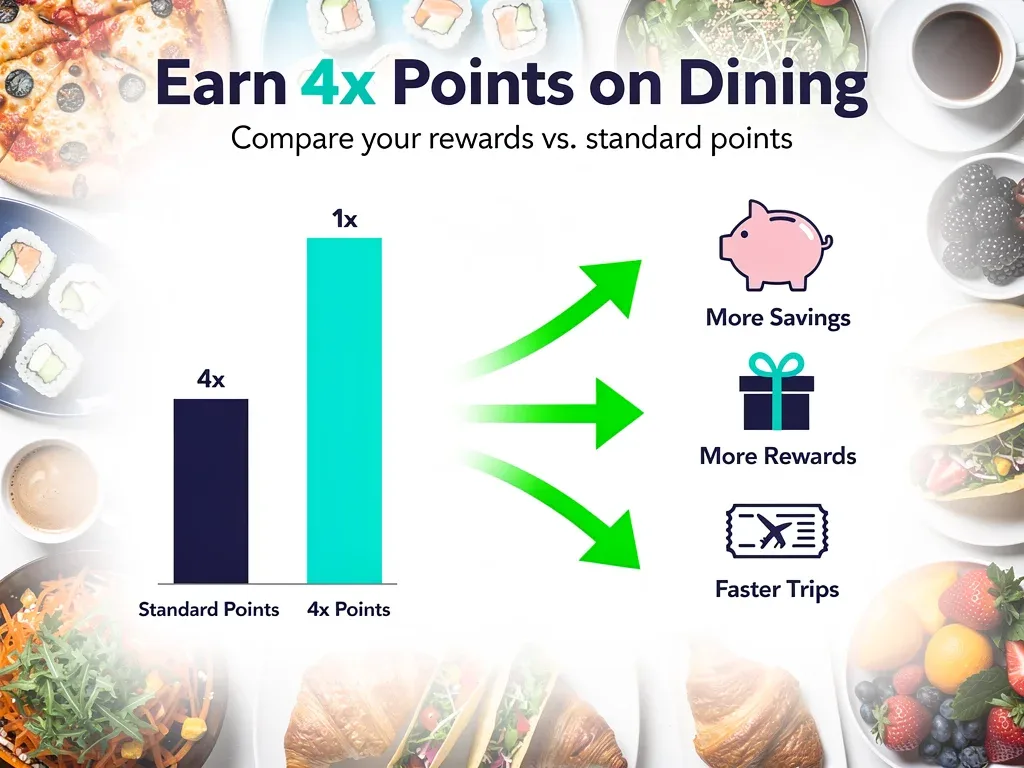
Four points per dollar does not automatically equal a 4% return because the value of a rewards point depends on how it is redeemed.
Cash-back programs are often easier to evaluate because the reward is denominated directly in dollars, while transferable points can have different values depending on redemption method.
A useful comparison therefore considers earning rate, redemption value, fees, credits, spending caps, and how often the cardholder actually uses each benefit.
Impact on Consumer Spending Habits
Dining multipliers can encourage cardholders to direct restaurant spending toward one card instead of spreading transactions across several payment methods.
However, earning additional rewards does not make restaurant spending inherently cheaper if the rewards encourage purchases that would not otherwise have been made.
The strongest financial benefit generally comes from using the appropriate rewards card for spending that was already part of the household budget.
Strategic Card Usage for Maximum Rewards
Consumers can begin by identifying which card in their wallet provides the strongest return on restaurant purchases under their normal spending habits.
They should then consider annual spending limits, because some elevated earning rates decline after a stated threshold is reached.
Regularly reviewing statements can also help confirm that transactions are being classified correctly and receiving the expected multiplier.
Eligibility and Enrollment Details
The 4X restaurant earning rate associated with the American Express Gold Card is tied to that specific card product rather than to a nationwide dining rewards program.
Cardholders generally earn the restaurant multiplier automatically on qualifying purchases, although separate dining credits and other benefits may require enrollment.
Applicants should review the current card agreement and benefit terms because annual fees, credits, merchant eligibility, and other features can change over time.
Who Can Earn 4X Points?
Eligible American Express Gold Card purchases at qualifying restaurants can earn 4X Membership Rewards points under the current rewards structure.
The elevated rate applies only up to the stated $50,000 annual restaurant spending cap, with subsequent eligible restaurant spending earning the standard 1X rate.
Other cards may offer 3X points, 3% cash back, rotating categories, or targeted promotions instead of a permanent 4X restaurant multiplier.
4X dining is associated with specific card products, not all rewards cards.
Annual spending caps may limit elevated earning rates.
Annual fees should be considered when calculating net value.
Comparing Current Rewards Structures
Different dining cards appeal to different types of consumers because rewards programs vary in complexity, flexibility, and cost.
The American Express Gold Card emphasizes Membership Rewards points and dining-related benefits, while other products may prioritize cash back or broader travel benefits.
The right comparison therefore depends on whether the cardholder prefers straightforward cash rewards, transferable points, statement credits, or travel-focused redemption options.
Analyzing the Real Value Proposition
A cardholder spending $5,000 annually at eligible restaurants would earn 20,000 Membership Rewards points at a 4X earning rate.
The dollar value of those points cannot be determined from the earning multiplier alone because different redemption options can provide different amounts of value.
The card's annual fee and the practical value of any credits the user actually consumes should also be subtracted when evaluating the overall benefit.
Annual Fees Matter
The American Express Gold Card currently carries a $325 annual fee, making it important to evaluate whether rewards and usable benefits justify that cost.
A consumer who spends heavily at restaurants and U.S. supermarkets may generate substantial points, while someone with limited spending in those categories may receive less value.
Credits should also be valued realistically rather than at their maximum advertised amount if the cardholder would not normally use the eligible merchants or services.
When a No-Annual-Fee Option May Be Better
A card with a lower earning rate can sometimes produce better net value if it has no annual fee and fits the consumer's actual spending habits.
For example, a straightforward cash-back card may appeal to consumers who do not want to manage transfer partners, credits, or different redemption values.
Comparing net annual value is more informative than selecting a card solely because its dining multiplier appears higher.
Strategic Implications for Restaurants
Restaurant rewards are primarily features of credit card programs rather than discounts provided directly by the restaurants themselves.
A restaurant typically does not need to join a special 4X network for an ordinary eligible transaction to receive the card's restaurant multiplier, although merchant coding still matters.
Separate partnerships, dining credits, and card-linked offers can create additional incentives at selected merchants beyond the standard restaurant earning rate.

Partnerships and Dining Credits
Credit card issuers increasingly combine restaurant earning rates with credits or partnerships involving specific dining platforms and merchants.
These benefits operate separately from the basic points multiplier and may have enrollment requirements, monthly limits, or merchant restrictions.
Cardholders should therefore distinguish between points earned on ordinary dining transactions and statement credits available only at selected businesses.
Maximizing Dining Rewards in 2026
The most effective strategy is to use rewards cards for purchases that were already planned rather than increasing spending solely to earn additional points.
Consumers should identify their primary dining card, understand its earning cap, and compare the value of points with alternative cash-back options.
Paying the statement balance in full is particularly important because interest charges can quickly exceed the value generated by dining rewards.
Stacking Rewards Responsibly
In many situations, consumers can earn credit card rewards while also participating in a restaurant's own loyalty program.
Card-linked offers, restaurant points, discounts, and credit card rewards may sometimes work together, although the terms of each program determine whether benefits can be combined.
Users should avoid making unnecessary purchases simply to trigger a reward or statement credit, since additional spending can eliminate the financial benefit.
Food Delivery and Takeout
Food delivery can qualify for elevated dining rewards under some card programs, but eligibility is not identical across issuers or delivery platforms.
The American Express Gold Card includes eligible takeout and delivery purchases in the United States within its restaurant rewards structure.
However, some third-party food delivery transactions outside the United States may not receive the same bonus, making geographic and merchant restrictions important.
Why Merchant Coding Matters
Credit card issuers generally rely on merchant category information transmitted with the transaction to determine whether a purchase receives a category bonus.
A restaurant located inside a hotel, casino, department store, or other establishment may occasionally be coded according to the larger business rather than as a standalone restaurant.
Because issuers do not always control merchant coding, consumers should review their rewards activity if an expected dining bonus does not appear.
Future Outlook for Dining Rewards
Dining remains a competitive rewards category because credit card issuers use everyday spending bonuses to attract and retain customers.
Current programs show that issuers are combining earning multipliers with credits, merchant partnerships, and travel benefits rather than competing solely on points per dollar.
Consumers should expect individual card terms to evolve over time even when a specific dining multiplier does not have a published expiration date.
What to Monitor Through 2026
Cardholders should monitor annual fees, dining credits, earning caps, redemption rules, and changes in eligible restaurant categories.
It is also useful to review competing products because issuers can update reward structures as they respond to changes elsewhere in the credit card market.
Official issuer terms should remain the primary source for determining current earning rates rather than third-party claims that a benefit has been extended through a specific date.
Potential Challenges and Considerations
Rewards programs can become complicated when annual fees, category restrictions, redemption values, spending caps, and credits are evaluated together.
A high earning multiplier can look attractive while providing limited practical value if the user rarely spends in the category or cannot efficiently redeem the resulting points.
There is also a risk of overspending when rewards are treated as a reason to make additional restaurant purchases rather than as a rebate on necessary or planned spending.
Navigating Program Terms and Conditions
Cardholders should review the issuer's definition of eligible restaurant purchases because not every food-related transaction automatically receives a dining bonus.
They should also understand what happens after any annual spending cap is reached, as the earning rate may fall substantially for the remainder of the calendar year.
Finally, consumers should compare the value of available redemption options because a point can be worth different amounts depending on how it is used.
Key Point | Current 2026 Information |
|---|---|
Amex Gold Dining | 4X Membership Rewards points at restaurants worldwide on up to $50,000 per calendar year, then 1X. |
Chase Sapphire Reserve | 3X points on eligible restaurant dining, including qualifying takeout and delivery. |
Capital One Savor | Unlimited 3% cash back on eligible dining purchases. |
Main Consideration | Compare annual fees, caps, redemption value, and actual spending rather than multipliers alone. |
Frequently Asked Questions About Dining Rewards Programs
Do all U.S. dining rewards programs now offer 4X points?▼
No. Dining reward rates vary substantially by card. The American Express Gold Card currently offers 4X Membership Rewards points on eligible restaurant purchases up to its annual cap, while other major cards use different earning structures.
Is the American Express Gold 4X dining benefit only available through the end of 2026?▼
Current American Express materials describe 4X restaurant earning as an ongoing card benefit rather than a promotion with a December 2026 expiration date. Card terms can change, so cardholders should continue monitoring official issuer information.
Do all restaurant purchases qualify for 4X?▼
No. Merchant classification and exclusions matter. Restaurants inside hotels or other establishments, catering transactions, certain bars or venues, and some third-party delivery purchases may not qualify for elevated restaurant rewards.
Does earning 4X points mean I receive 4% cash back?▼
Not necessarily. Four Membership Rewards points per dollar are not automatically equivalent to 4% cash back because their value varies depending on the redemption method used.
Can restaurant loyalty rewards be combined with credit card points?▼
Often they can. A cardholder may be able to earn the credit card's restaurant rewards while also earning points through a restaurant loyalty program, although the specific terms of each offer should be checked.
What This Means
The most important takeaway for 2026 is that 4X dining rewards are real but product-specific, rather than the result of a universal change across U.S. rewards programs.
The American Express Gold Card remains a major example, offering 4X at eligible restaurants worldwide up to $50,000 in annual restaurant purchases, while competing cards use different points or cash-back structures.
Consumers can make more informed comparisons by focusing on net value after annual fees, spending caps and redemption differences instead of assuming that the highest advertised multiplier automatically produces the best return.