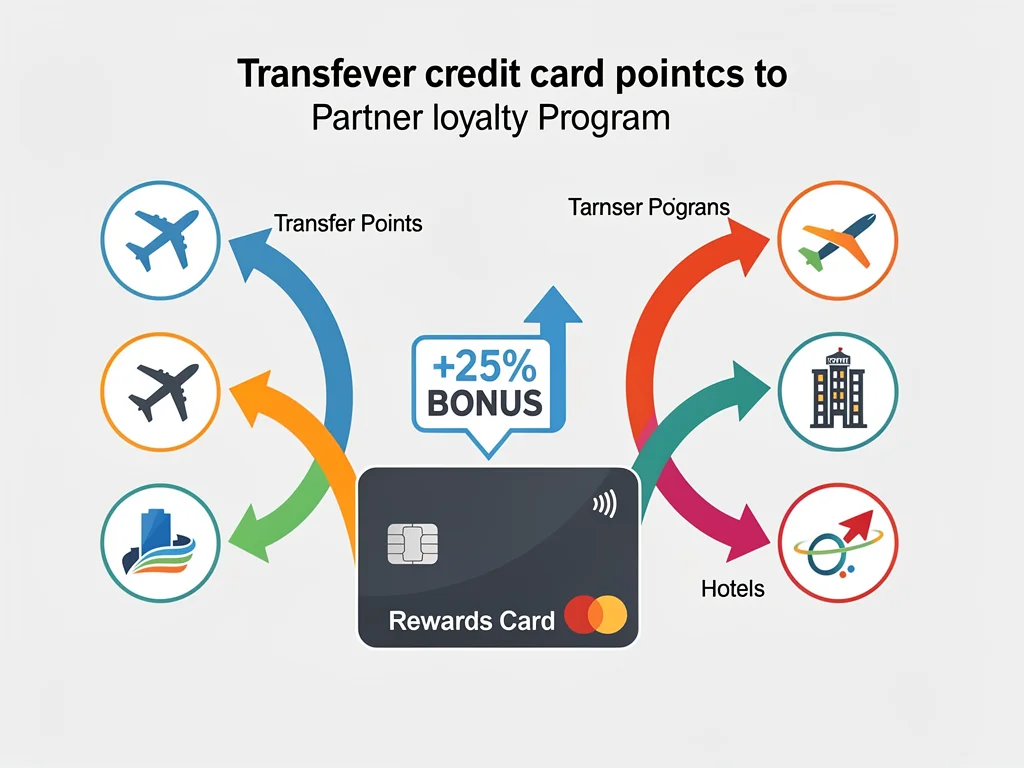
Maximize Your Points: Credit Card Transfer Bonus Perks for 25% More Value
Effectively leveraging credit card transfer bonus perks can significantly increase the value of your points, often by 25% or more, enabling enhanced travel experiences or greater savings.
Por: Lucas Bastos em 18 de fevereiro de 2026
Última atualização em: 26 de junho de 2026
Advertisements
Effectively leveraging credit card transfer bonus perks can significantly increase the value of your points, often by 25% or more, enabling enhanced travel experiences or greater savings.
Are you looking to stretch the value of your credit card rewards even further? Understanding how to leverage credit card transfer bonus perks can be a game-changer, potentially boosting your points’ worth by 25% or more, leading to significant financial impact.
Advertisements
Understanding Credit Card Transfer Bonuses
Credit card transfer bonuses are promotional offers from credit card issuers that provide additional points or miles when you transfer your rewards currency to a specific airline or hotel loyalty program. These bonuses are designed to incentivize cardholders to move their points, often leading to much greater value than a direct cash redemption.
The core concept is simple: instead of redeeming your points for a fixed cash value, which is usually low, you convert them into a partner currency during a promotional period. This conversion often comes with an added percentage, making your original points worth more in the new program.
What are Transfer Partners?
Most major credit card rewards programs, such as Chase Ultimate Rewards, American Express Membership Rewards, Citi ThankYou Rewards, and Capital One Venture Rewards, have a network of travel partners. These partners are typically airlines and hotels that allow you to convert your credit card points into their respective loyalty currencies.
Airlines: Partners often include major global carriers like United, Delta, British Airways, and more, opening up opportunities for award flights.
Hotels: Programs like Marriott Bonvoy and Hilton Honors are common partners, offering redemptions for free night stays.
Variety: The specific partners vary by credit card issuer, so it’s crucial to know your card’s ecosystem.
Understanding these partnerships is the first step in unlocking the true potential of your credit card points. Without a clear picture of who you can transfer to, you might miss out on valuable redemption opportunities.
How Do Transfer Bonuses Work?
When a transfer bonus is active, the credit card issuer announces a limited-time offer. For example, they might offer a 25% bonus when you transfer points to a specific airline. This means if you transfer 10,000 credit card points, you would receive 12,500 airline miles in return. This additional 2,500 miles can make a significant difference in securing a higher-value redemption.
These bonuses are not constant; they come and go, often lasting for a few weeks to a month. Being aware of these promotions and acting quickly when they align with your travel goals is key to maximizing their value. It’s a strategic move that requires a bit of planning and attention to detail.
In essence, transfer bonuses provide a window of opportunity to amplify your rewards. By staying informed and understanding the mechanics, you can transform ordinary point redemptions into extraordinary travel experiences.
Identifying the Best Transfer Bonus Opportunities
Not all transfer bonuses are created equal, and knowing how to identify the most lucrative ones is crucial for maximizing your point value. This involves understanding the typical bonus percentages, recognizing the value of different loyalty programs, and timing your transfers strategically.
The goal is to ensure that the bonus genuinely adds significant value to your travel plans, rather than just moving points from one account to another without a clear benefit. A well-chosen transfer bonus can turn a standard economy flight into a business class experience or extend a hotel stay for an extra night.
Typical Bonus Percentages and Their Impact
Transfer bonuses typically range from 15% to 50%, with 25% often being a common and highly sought-after offer. A 25% bonus means that for every 10,000 points you transfer, you receive 12,500 miles or hotel points. This increase can be substantial, especially for large transfers.
15-20% Bonus: Still valuable, especially if it aligns perfectly with an immediate redemption need.
25-30% Bonus: Often considered a sweet spot, offering a solid boost to your points.
40-50% Bonus: These are rarer and extremely valuable, representing exceptional opportunities to stretch your rewards.
The impact of these percentages cannot be overstated. For example, if a flight costs 50,000 miles, a 25% bonus means you only need to transfer 40,000 credit card points instead of the full 50,000. This effectively saves you 10,000 points, which can then be used for another redemption.
Valuing Different Loyalty Programs
The true value of a transfer bonus also depends on the loyalty program you’re transferring to. Some airline miles or hotel points are inherently more valuable than others due to their redemption charts, award availability, and the cost of revenue tickets/stays.
Before transferring, research the specific program’s value. For instance, some airline miles might be worth 1.5 cents per mile, while others are only worth 1 cent per mile. A 25% bonus to a program with higher intrinsic value will yield a much better return. Consider the following:
Award Chart Sweet Spots: Look for programs known for offering great value on specific routes or hotel categories.
Availability: Even a high-value program is useless if you can’t find award space for your desired dates.
Flexibility: Some programs offer more flexibility in booking or changing awards than others.
A deep understanding of loyalty program economics ensures that you’re not just chasing a percentage, but rather maximizing the actual utility and financial impact of your points. This strategic approach transforms points into tangible, valuable experiences.
Strategic Timing for Maximum Value
Timing is paramount when it comes to leveraging credit card transfer bonuses. Transferring points impulsively can lead to suboptimal outcomes, as points, once transferred, generally cannot be moved back to your credit card account. Therefore, a well-thought-out strategy is essential to capture the highest possible value.
The key is to align your transfer with both an active bonus offer and a concrete travel plan. This minimizes the risk of points devaluation within a partner program and ensures your boosted points are used for an immediate, high-value redemption.
Monitoring for Bonus Announcements
Credit card issuers and loyalty programs regularly announce transfer bonuses through various channels. Staying informed about these announcements is the first step in strategic timing. There are several ways to keep track:
Credit Card Company Emails: Subscribe to emails from your credit card issuer for direct notifications.
Travel Blogs and Websites: Many specialized travel rewards blogs actively track and report on current transfer bonuses.
Loyalty Program Websites: Directly check the promotions sections of your preferred airline and hotel loyalty programs.
Setting up alerts or regularly checking these sources can ensure you don’t miss a valuable opportunity. These bonuses are often unannounced until they go live, so proactive monitoring is key to catching them before they expire.
Transferring Only When Needed
A common mistake is transferring points speculatively, hoping to use them later. This carries significant risks, as loyalty programs can devalue their points at any time, making your transferred points worth less. The golden rule is to only transfer points when you have a specific redemption in mind and have confirmed award availability.
For example, if you find an award flight on an airline partner that requires 60,000 miles, and there’s a 25% transfer bonus active, you would transfer 48,000 credit card points to get 60,000 miles. This ensures your points are used efficiently and immediately for a confirmed booking.
By waiting until you have a concrete plan and confirmed availability, you mitigate the risk of devaluation and ensure the bonus directly contributes to a tangible travel benefit. This approach maximizes the financial impact of your points by preventing them from sitting idle and losing value.
Common Pitfalls and How to Avoid Them
While credit card transfer bonuses offer immense value, they also come with potential pitfalls that can diminish their benefits if not carefully navigated. Awareness of these common mistakes and proactive measures to avoid them are essential for a successful rewards strategy.
From points expiration to unexpected fees, understanding the nuances of point transfers will help you ensure that the bonus truly translates into financial gain and not unforeseen headaches. Diligence and careful reading of terms and conditions are your best allies.
Understanding Transfer Ratios and Fees
Always pay close attention to the transfer ratio and any associated fees. While most credit card programs offer a 1:1 transfer ratio (e.g., 1 credit card point equals 1 airline mile), some might have less favorable ratios, even with a bonus. For example, a 2:1 transfer ratio with a 25% bonus still means fewer miles than a 1:1 transfer without a bonus.
Excise Tax Offset Fee: American Express, for instance, charges a small excise tax offset fee when transferring Membership Rewards points to U.S.-based airlines. This is usually a fraction of a cent per point, but it’s important to be aware of.
Minimum Transfer Increments: Most programs require transfers in specific increments, often 1,000 points. Ensure your transfer amount meets these requirements.
These details, though seemingly minor, can impact the overall value of your transfer. Always calculate the net points you will receive after any ratios or fees to accurately assess the bonus’s worth.
Beware of Points Devaluation and Expiration
Once points are transferred to an airline or hotel loyalty program, they are subject to that program’s rules, including potential devaluations and expiration policies. Unlike credit card points, which often don’t expire as long as your account is open, many airline miles or hotel points have expiration dates if there’s no account activity.
Devaluations are another significant risk. Loyalty programs can change their award charts or increase the number of points required for redemptions without much notice. This means that points transferred today for a specific redemption might be worth less tomorrow.
To mitigate these risks:
Transfer only for immediate use: As previously mentioned, this is the best defense against devaluation and expiration.
Understand expiration policies: Know if and when the transferred points will expire and what activity is required to extend their validity.
Diversify your points: Don’t put all your eggs in one basket by transferring all your points to a single program unless you have a confirmed, high-value redemption.
By being mindful of these factors, you can protect the value of your boosted points and ensure they contribute positively to your financial goals.
Case Studies: Realizing 25% More Value
To truly appreciate the financial impact of credit card transfer bonus perks, examining real-world scenarios can be incredibly insightful. These case studies demonstrate how a 25% bonus can transform a good redemption into an excellent one, providing tangible examples of enhanced value.
The power of these bonuses lies in their ability to unlock aspirational travel experiences or significantly reduce the cost of essential travel, making premium cabins or luxury stays more accessible to the savvy points earner.
Example 1: Upgrading a Flight Experience
Imagine you’ve accumulated 80,000 credit card points, and you’re eyeing a business class flight that costs 100,000 airline miles. Without a transfer bonus, you’d be 20,000 miles short, or you’d need to earn more points, delaying your trip.
However, if your credit card issuer offers a 25% transfer bonus to that airline’s loyalty program, the math changes dramatically:
In this scenario, your 80,000 credit card points, when transferred with the bonus, become 100,000 airline miles, exactly what you need for that business class flight. This means you effectively saved 20,000 credit card points, or rather, received 25% more value from your existing points, turning a previously unattainable redemption into a reality.
Example 2: Extending a Hotel Stay
Consider a situation where you want to book two nights at a luxury hotel, and each night costs 30,000 hotel points, totaling 60,000 points. You have 50,000 credit card points.
If there’s a 20% transfer bonus to the hotel loyalty program, here’s the impact:
Original Points Needed: 60,000 hotel points for two nights.
Your 50,000 credit card points, when transferred with the 20% bonus, yield exactly 60,000 hotel points. This allows you to book both nights without needing to earn additional points or pay cash for one of the nights. This bonus effectively gave you an extra 10,000 hotel points, allowing for a longer stay or a more valuable room category.
These examples highlight how understanding and utilizing transfer bonuses can directly translate into tangible financial benefits, making your travel dreams more achievable and more luxurious.
Advanced Strategies for Maximizing Transfer Bonuses
Beyond the basics, there are more advanced strategies that seasoned points enthusiasts employ to squeeze even greater value from credit card transfer bonuses. These tactics often involve a deeper understanding of loyalty program intricacies and a willingness to plan further ahead.
From combining points to leveraging specific program quirks, these strategies aim to optimize every single point, ensuring that your efforts yield the absolute best possible returns for your travel and financial goals.
Combining Points from Multiple Sources
Many individuals hold multiple credit cards from different issuers. A sophisticated strategy involves understanding how to combine points from various sources to reach a high-value redemption, especially during a transfer bonus. While you cannot directly combine points from different credit card programs (e.g., Chase Ultimate Rewards with Amex Membership Rewards), you can often combine points within the same loyalty program.
Household Transfers: Some credit card programs allow you to transfer points to another member of your household, which can be useful if one person has more points or a specific card with a better transfer bonus opportunity.
Strategic Accumulation: Focus your spending on cards that earn flexible points in programs with frequent and generous transfer bonuses to partners you value most.
This approach requires careful tracking of your point balances across different accounts and a clear understanding of the transfer rules for each program. When executed correctly, it can unlock redemptions that would be out of reach with points from a single source.
Leveraging Sweet Spots and Award Charts
Every airline and hotel loyalty program has its ‘sweet spots’ – redemptions that offer exceptionally high value compared to their cash cost. These are often found in specific regions, for certain cabin classes, or during off-peak seasons. Identifying these sweet spots and then applying a transfer bonus can lead to truly incredible value.
For example, some programs might offer business class flights to Europe for fewer miles than an economy flight on another airline. If a transfer bonus aligns with such a sweet spot, your points can deliver disproportionate value.
Research Award Charts: Regularly review partner award charts to find these high-value redemptions.
Flexibility with Dates: Being flexible with your travel dates significantly increases your chances of finding award availability, especially for sweet spot redemptions.
Utilize Stopovers and Open-Jaws: Some loyalty programs allow for complex itineraries that can further enhance the value of your redeemed miles.
By pairing a transfer bonus with a known sweet spot, you’re not just getting 25% more points; you’re often getting 25% more points on an already undervalued redemption, creating exponential savings and financial impact. This level of optimization requires dedication but yields substantial rewards.
The Financial Impact and Long-Term Benefits
The financial impact of strategically leveraging credit card transfer bonus perks extends far beyond simply getting a better deal on a single flight or hotel stay. It contributes to a more robust personal finance strategy, allowing for significant savings on travel expenses, which can then be allocated to other financial goals.
Over the long term, a consistent approach to maximizing these bonuses can lead to substantial wealth creation, as you effectively reduce one of life’s major expenses: travel.
Saving Money on Travel Expenses
The most immediate and obvious financial benefit is the direct savings on travel. Instead of paying cash for flights and hotels, you’re using points that you’ve earned through everyday spending. When those points are boosted by 25% or more, the cash equivalent of your redemption increases proportionally.
Reduced Cash Outlays: Freeing up cash that would otherwise be spent on travel.
Access to Premium Travel: Making aspirational travel like business or first class flights, or luxury hotel stays, attainable without the hefty cash price tag.
More Frequent Travel: With points going further, you can potentially travel more often for the same amount of effort in earning rewards.
These savings can be redirected towards investments, debt repayment, or other savings goals, thereby accelerating your financial progress. It transforms your credit card into a powerful financial tool, not just a payment method.
Building a Sustainable Rewards Strategy
For those who commit to understanding and utilizing transfer bonuses, it becomes a core component of a sustainable rewards strategy. This involves not just chasing the next bonus, but integrating it into a broader plan for earning and redeeming points.
A sustainable strategy includes:
Diversified Point Earning: Holding a portfolio of credit cards that earn flexible points in different programs.
Regular Monitoring: Staying updated on transfer bonuses, award chart changes, and loyalty program news.
Goal-Oriented Redemptions: Having specific travel goals in mind to ensure transfers are purposeful and high-value.
By consistently applying these principles, you can ensure that your credit card points continuously generate outsized value, making travel more affordable and enjoyable for years to come. This proactive approach to managing your rewards contributes significantly to your overall financial well-being and expands your travel horizons.
Key Point
Brief Description
Transfer Bonuses Explained
Promotional offers granting extra points when transferring credit card rewards to airline or hotel partners, boosting value.
Strategic Timing
Only transfer points when a bonus is active and a specific, confirmed redemption is planned to avoid devaluation.
Avoiding Pitfalls
Be aware of transfer ratios, fees, and potential points devaluation or expiration in partner programs.
Financial Impact
Significant savings on travel expenses, enabling more frequent or luxurious trips, and contributing to overall financial health.
Frequently Asked Questions About Credit Card Transfer Bonuses
What exactly is a credit card transfer bonus?▼
A credit card transfer bonus is a limited-time promotion where credit card issuers offer additional points or miles when you convert your credit card rewards to a specific airline or hotel loyalty program. This allows you to get more value from your points for travel redemptions.
How often do these transfer bonuses occur?▼
Transfer bonuses are not on a fixed schedule but occur periodically throughout the year. Major credit card issuers typically offer several bonuses annually with various partners. It’s wise to monitor travel blogs and your card issuer’s communications for announcements.
Can I transfer points back to my credit card account after a bonus?▼
Generally, no. Once you transfer your credit card points to an airline or hotel loyalty program, they cannot be transferred back to your credit card rewards account. This is why it’s crucial to have a confirmed redemption plan before initiating a transfer.
Are there any fees associated with transferring points?▼
Some credit card issuers, like American Express, may charge a small excise tax offset fee for transfers to U.S.-based airlines. This fee is usually minimal, a fraction of a cent per point, but it’s important to be aware of any potential charges before transferring.
What is the best way to find out about current transfer bonuses?▼
The best way to stay informed about current transfer bonuses is to subscribe to email newsletters from your credit card issuers, follow reputable travel rewards blogs, and regularly check the promotions sections on the websites of your preferred airline and hotel loyalty programs.
Conclusion
Leveraging credit card transfer bonus perks is an advanced yet highly effective strategy for maximizing the value of your rewards. By understanding how these bonuses work, identifying the best opportunities, and timing your transfers strategically, you can significantly enhance your travel experiences and achieve substantial financial savings. This proactive approach not only makes aspirational travel more accessible but also integrates seamlessly into a broader personal finance strategy, turning your everyday spending into extraordinary value. The financial impact of a 25% or even higher bonus can transform your points from a simple reward into a powerful tool for achieving your travel and savings goals.
I'm a content creator fueled by the idea that the right words can open doors and spark real change. I write with intention, seeking to motivate, connect, and empower readers to grow and make confident choices in their journey.